
Every week, we bring you fascinating videos, chosen by you, through your likes.

Despite presiding over scores of factories in what is today India's largest garment exporter with 105,000 employees, Ahuja is a modest man with much to be immodest about. He tells Rahul Jacob that the government needs a free trade agreement with Europe fast to ensure a level-playing field with Bangladesh and Vietnam.

'I found it unbelievable that L&T said 45,000 jobs were waiting to be filled because of unavailability of suitable skillsets.' 'So, when the Opposition sweepingly says there are no jobs, I'm sorry... I'm not saying it's raining jobs, but there are jobs. The (skill) gap has to be bridged.'

Any government support or incentive to help exporters deal with high freight and insurance costs is unlikely.

If the concerns over risking political capital are overcome, the long-term gains for the Indian economy will be immense, asserts A K Bhattacharya.

The apparel and engineering sectors have already witnessed the trend in the past one week. If this continues, it can have an impact on the overall export demand in the coming months, considering that Europe is the largest national export market for India.

Domestic customers will get access to high-quality Swiss products such as watches, chocolates, biscuits, and clocks at lower prices as India will phase out customs duties under its trade pact with the EFTA bloc on these goods over a period of time. India and the four-European nation bloc EFTA signed a trade and economic partnership agreement (TEPA) on Sunday to boost trade and investments between the two regions. The European Free Trade Association (EFTA) members are Iceland, Liechtenstein, Norway, and Switzerland.

Work on a dozen decisions to start by next week.

US-based retail giant Walmart is looking to source toys, shoes and bicycles from Indian suppliers as the company is targeting to increase its exports from India to USD 10 billion annually by 2027. The company also wants to develop new suppliers in categories such as food, pharmaceuticals, consumables, health and wellness, and apparel and home textiles, a company spokesperson told PTI. Officials from the Bentonville-headquartered firm recently held a virtual meeting with several domestic toy manufacturers in India.

The Indian industry is not yet fully prepared for the complete elimination of tariffs in the World Trade Organisation identified seven key sectors, including textiles and auto components, the PHD Chamber of Commerce and Industry has said.

Global funds, according to Christopher Wood, global head of equity strategy at Jefferies, are now beginning to pay more attention to India with the market now offering 30 companies with a market capitalisation over $25 billion.
After the Bt Cotton boom, Indian farmers are all set to reap rich dividends from a slump in cotton spinning in Britain.

These flights belong to the fleet of Air India, Air India Express, IndiGo, Spice Jet, Vistara, Go Air, and also planes from Air Force.

The interim free trade agreement between India and Australia will come into force on Thursday, providing duty-free access to thousands of domestic goods such as textiles, and leather in the Australian market. The agreement will help almost double the bilateral commerce to $45-50 billion in around five years, according to exporters and industry players. The Economic Cooperation and Trade Agreement (ECTA), which was signed on April 2, would provide duty-free access to Indian exporters of over 6,000 broad sectors, including textiles, leather, furniture, jewellery and machinery in the Australian market.
Dr Vijay Kelkar, adviser to the finance minister, will meet industry representatives on Monday in Mumbai to discuss his indirect tax proposals as well as pre-Budget issues.

'The government wants farmers to diversify from rice and wheat, and create another green revolution. Cannabis can play a big part in that'

Gaurav Gupta returns to the LFW ramp after four years to give a new meaning to centuries old crafts.

Reliance Industries chairman Mukesh Ambani might have made news for purchasing the most expensive beach-side villa in Dubai recently, but he is not the only Indian eyeing the city for investment. Since Dubai allowed foreign investors full ownership in specific sectors in June 2021, a horde of Indian companies have moved or expanded into the desert city. The list even includes a kindergarten, an elementary and middle school, and a hotel that has sought 100 per cent ownership.
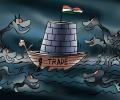
The talks for a free trade agreement (FTA) between India and Canada may have taken a pause but will resume once the political row between the two countries is resolved as the pact has economic benefits for both the nations, trade experts and exporters said on Friday. However, they said that India may not hurry for the trade agreement as 60 per cent of New Delhi's exports are already entering Canada at zero duty. Earlier this month, India and Canada paused the negotiations for the agreement due to political reasons.

The chemicals sector's recovery could be delayed until FY25 if the current trends of weak demand and flat pricing continue. Following a subdued September quarter, the revenue and profit performance of listed chemicals companies are anticipated to fall short of initial expectations of an improvement. Despite some price stability, the demand trajectory remains uncertain.

'It is time the government should intervene more strongly than ever before and save the textile industry which is the pride of our nation.'

... while learning from past tech revolutions, suggests Ajit Balakrishnan.
The weak April-June quarter (first quarter, or Q1) results of the largest listed specialty chemical maker, SRF, and multiple global headwinds for the sector are expected to weigh on the prospects of Indian specialty chemical companies in 2023-24 (FY24). Stocks in the sector (down 7-18 per cent) have underperformed the benchmarks (up over 10 per cent) in the past three months, and given the multiple challenges, the trend is likely to continue. Kotak Institutional Equities expects a very weak quarter (Q1FY24) for the sector due to destocking, demand weakness across certain critical end-use industries, and price erosion amid intense competition from Chinese suppliers.

A vast majority of the business leaders believe that the Production Linked Incentive (PLI) schemes have been beneficial and expect an extension to other sectors in the coming years, a Deloitte Survey said on Friday. An overwhelming number of survey respondents hope the budget will fuel growth across industries by building strong domestic demand and focussing on capital expenditure and believe that it would define the 'Amrit Kaal'. "Critical to this growth will be the pace of capital expenditure, infrastructure development, and the need to boost infrastructure financing through private partnership. 60 per cent of respondents suggested raising funds through Indian Government Bonds," the survey said.

Prime Minister Narendra Modi on Tuesday met business leaders to hear their grievances on issues ranging from high capital cost to ease of doing business to certainty on taxation matters, as he interacted for the first time with the Indian industry chambers since taking charge over a year ago.

Ahmedabad's cultural scene would not have gone beyond the garba, but for Mrinalini Sarabhai's pioneering efforts.

The grand old man of Indian hospitality, Captain C P Krishnan Nair passed away at a private hospital in Mumbai on Saturday.

Almost 53 per cent of the companies covered by the survey felt that high cost of credit was creating a problem for India Inc.
Demand will boom in the US and China, but exporters say it will be difficult for India to tap these markets.

While the UK will possibly go into recession, the bigger fear is copycat referendums from other EU nations.

The government has also set targets for the next 25 years. We are working on the target of becoming a $5-10 trillion economy as well as taking exports to a record high, he said.

Centre mulls strategy to ensure powers given to the agencies are not misused.

The textile industry is the second-largest employer in the country, employing about 32 million, and the government is banking on it to absorb millions of youth.

'Indian entrepreneurs became traders for Chinese goods rather than producers of goods.'
Asian Development Bank (ADB) has kept its outlook for India's economic growth unchanged at 7 per cent for the current fiscal year while forecasting a weaker-than-previously expected pace for developing Asia. ADB's 7 per cent growth projection for fiscal 2022-23 (April 2022 to March 2023), unchanged from its September forecast, compares to 8.7 per cent GDP growth in 2021-22. For 2023-24, the GDP growth has been kept unchanged at 7.2 per cent.

'India's manufacturing will take 10-15 years to catch up with China.'
Exports declined for the fourth-consecutive month by 10.3 per cent year-on-year to $34.98 billion in May, while the trade deficit widened to a five-month high of $22.12 billion. According to the data released by the commerce ministry on Thursday, key export sectors recording negative growth include petroleum products, gems and jewellery, engineering goods, ready-made garments of all textiles and chemicals. Imports also declined 6.6 per cent, six-month in a row, to $57.1 billion against $61.13 billion in the same month last year, the data showed.

"Looking at the films come to life on set was a lot of fun. The lensing, the art direction and Prakash Sir's detailed eye. It felt like something special was brewing," says Naina Bhan.
The wholesale price-based inflation eased for the eighth consecutive month to 4.73 per cent in January on easing prices of manufactured items, fuel and power. The wholesale price-index (WPI) based inflation rate was 4.95 per cent in December 2022 and 13.68 per cent in January 2022. Inflation in food articles, however, rose to 2.38 per cent in January, from (-) 1.25 per cent in December, 2022.
 © 2026 Rediff.com - Advertise with us - Disclaimer - Privacy Policy - Sitemap - Feedback - About us - Terms of use - Grievances